 G.A. Logix Logiciels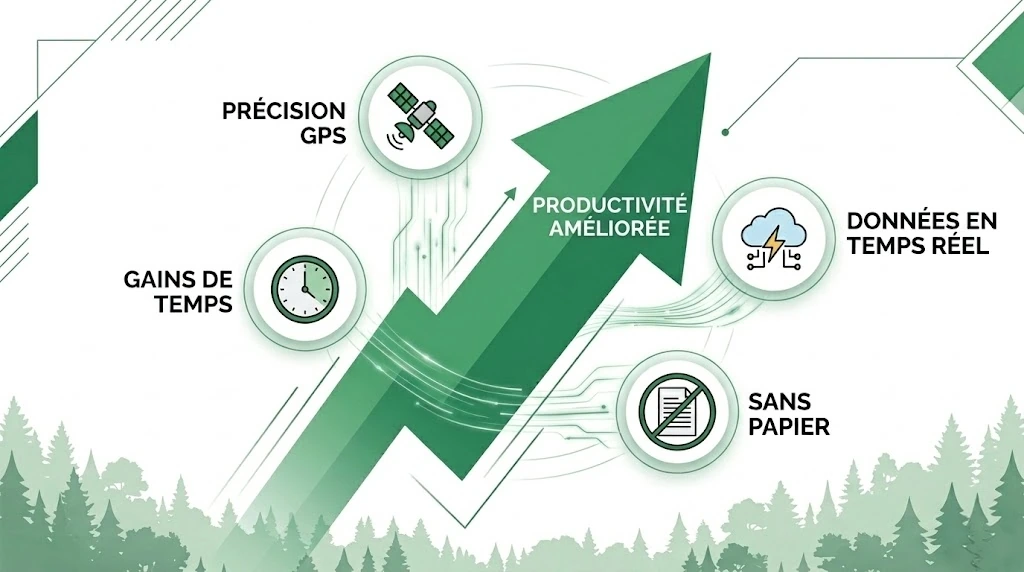
Quebec's forestry industry is undergoing a period of profound transformation. While other sectors have already widely adopted digital tools, forestry is now accelerating its transition, driven by growing regulatory requirements, a persistent labour shortage and the productivity gains documented by pioneering companies. Here is an overview of the state of digital transformation in our industry.
The state of digital adoption in Quebec
The picture of technology adoption in Quebec's forestry sector remains mixed. On one hand, large companies and joint management organizations (OGC) have made significant investments in digital management platforms in recent years. On the other, many small and medium-sized forestry contractors still use manual methods for a significant portion of their operations. Based on our team's field observations, approximately 60% of Quebec forestry companies have begun some form of process digitization, but only 25% have achieved an advanced level of digital maturity.
Regulatory requirements as a driver of change
The Ministry of Natural Resources and Forests (MRNF) plays a decisive role in accelerating digital transformation. Requirements for wood traceability, electronic transmission of measurement data and forestry operations mapping standards are pushing companies to adopt digital tools. The trend toward more rigorous accountability and detailed environmental reporting makes paper-based systems increasingly unsuitable for the realities of the sector.
Measurable productivity gains
Companies that have made the digital shift report impressive results. Studies on digital transformation in field operations show that automating administrative processes can reduce paperwork and double-entry time by up to 40%. Transcription errors, once common, are virtually eliminated. The availability of real-time data enables faster and better-informed decision-making, while automatic report generation frees up valuable hours each week for managers and administrative staff.
Labour shortage accelerates adoption
Paradoxically, the labour shortage has proven to be one of the most powerful drivers of digital transformation. Faced with the difficulty of recruiting qualified personnel, forestry companies are turning to technology to do more with less. Automation of administrative tasks, GPS tracking of operations and optimized planning tools help maintain productivity despite reduced crews. This reality is pushing even the most reluctant companies to seriously consider the technology shift.
Obstacles to overcome
Despite the obvious advantages, several obstacles still slow large-scale adoption. Limited connectivity in forest areas remains the number one challenge: without reliable internet access, real-time data synchronization remains problematic. The initial cost of the transition — hardware acquisition, software licences, staff training — can seem prohibitive for small businesses. Finally, resistance to change from some experienced workers, accustomed to methods proven over decades, requires sustained support and a concrete demonstration of the benefits.
Future outlook and the role of G.A. Logix
The future of Quebec's forestry industry is decidedly digital. The integration of artificial intelligence for planning optimization, the growing use of drones for forest inventory and the development of connected sensors for environmental monitoring are just a few of the innovations that will transform the sector in the coming years. At G.A. Logix, we are committed to supporting every forestry company through this transition, by offering solutions adapted to their reality, hands-on support and tools designed specifically for the Quebec forestry context. Contact us to discuss your digital transformation project.