 G.A. Logix Software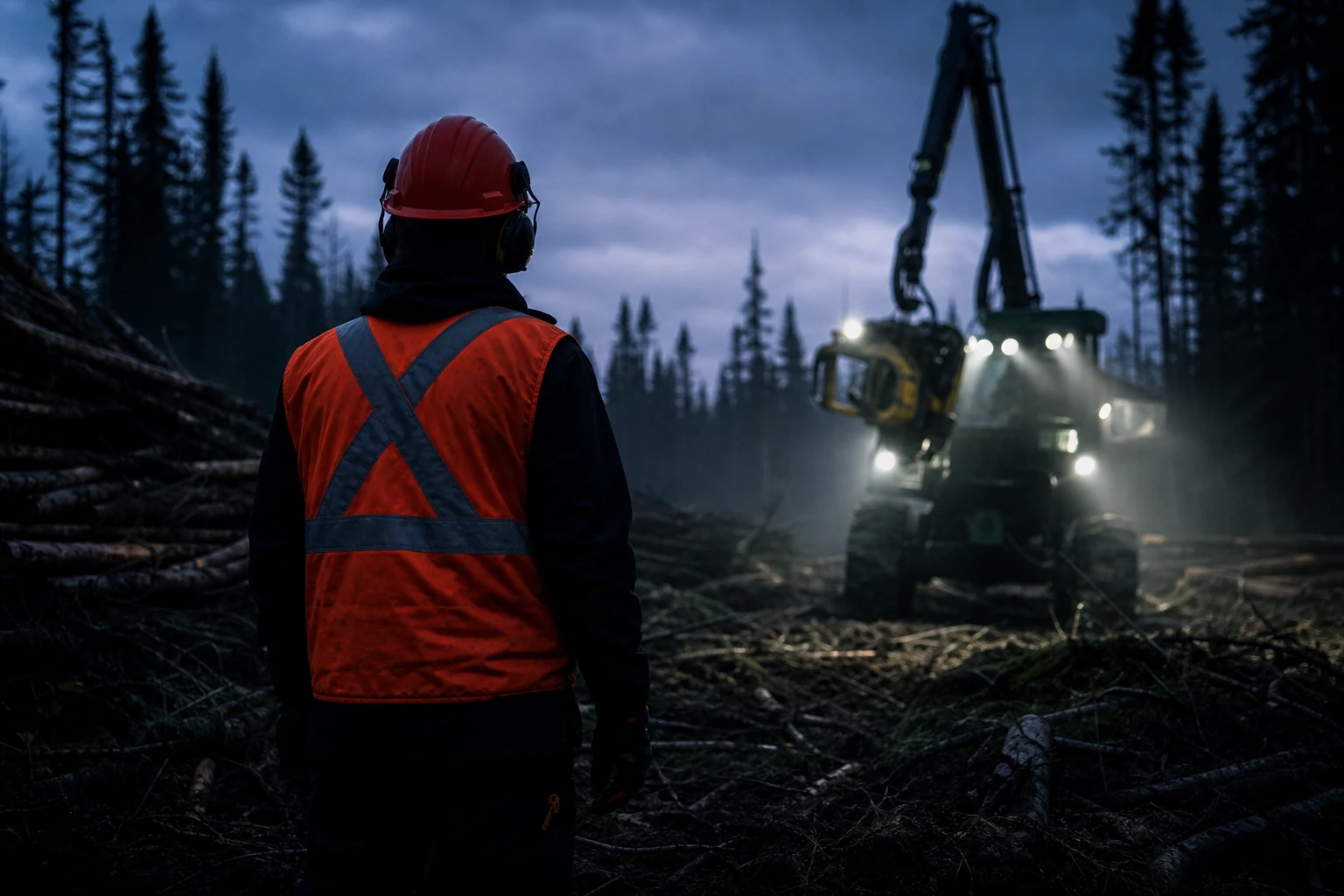
While a harvester works in the forest, its head measures every stem it processes: species, length, diameter, volume, position. In a single day, one machine generates thousands of measurements. So the question is not whether the data exists. The real question is how much of that data actually makes it to the office, and in what shape.
In many forestry companies, the answer is disappointing. The numbers stay locked inside the machine, exported by hand when someone remembers, transferred to a USB key that ends up forgotten in the cab, or emailed as an attachment on Friday evening. The result: volumes are managed a week behind, and valuable time is lost rebuilding a production picture from scattered pieces.
At G.A. Logix, we have been tackling this problem for a long time. Here is how, concretely.
The real problem: data trapped in the machine
A harvester head is an onboard measuring computer. It knows what it cuts, at what length, in which species. The catch is that each brand records this information its own way, in its own database, in its own format.
For a contractor who owns machines from several brands, that means just as many different extraction methods. For a prime contractor working with several subcontractors, it is even worse: they receive heterogeneous files, when they receive them at all. The data is there. It is just hard to get out, and even harder to consolidate.
Our approach: reading directly from the machines
Our solution is simple to explain: we read directly from the machine's onboard database. We do not ask the operator to produce an exchange file. We do not depend on a manual export. We read the source.
Let us be precise here, because this is often misunderstood in the industry: we do not read a standardized forestry exchange file. We read the machines' own databases, then we process the data. It is an important technical distinction.
Four harvester head brands are supported today:
- Komatsu
- Ponsse
- LogMax
- Logset
Whichever of these brands equips your fleet, the logic stays the same from the user's point of view: you select your harvest block, and the production data arrives at the office, ready to be analyzed.
SyncLogix and ForestLogix: two sides of the same flow
Two G.A. Logix products work together to make all of this possible:
- SyncLogix is the pipeline that captures production data directly from the machines and synchronizes it to the G.A. Logix cloud. It runs in the background, with no user intervention.
- ForestLogix is the forestry operations management platform where that data becomes available at the office: mapping, tables, segmentation and exports.
In short: SyncLogix feeds the cloud with harvester head production data, and ForestLogix lets you consult and analyze it at the office. One captures, the other exploits.
Concretely, what it looks like at the office
The workflow is straightforward:
- In ForestLogix, select one or more harvest blocks from the list provided by the G.A. Logix server.
- The harvester head production data is downloaded for those blocks.
- The download and heavy processing run in the background: work can continue in the meantime.
- At the end, the data appears as geospatial layers and tables, ready to be mapped, segmented and exported.
Segmentation is done notably by machine and by operator. That is precisely the level of detail that turns a mass of measurements into useful management information. And since block selection works in batch, a weekly production review covering several cut blocks comes together in a single operation, instead of repeating the same steps ten times.
Data that stays within reach
Downloaded data is not displayed once and then lost: it remains available locally on the workstation, so it can be queried and reused without triggering a new download every time. Concretely, a block can be reopened the next day, analyses reworked and exports produced, even if the office connection is acting up that morning.
It is a detail that matters in real life: regional office networks are not always perfect, and nobody wants to wait for a full re-download just to adjust a symbology.
What it changes for a forestry manager
If you run a cooperative, a forest management group, a harvesting company, or if you are a prime contractor, the benefit is strategic. You get a consolidated view of your harvesters' production, by block, by machine and by operator, without depending on a manual export specific to each operator.
That means volumes and species available for monitoring, without the Friday file chase. That means fewer gaps between what you invoice and what you actually produced. And it means you can answer your board or your client with numbers, not estimates.
All of it delivered by a team based in Plessisville that understands the Quebec context: public forest, MRNF, RADF, and the daily reality of mechanized harvesting.
What it changes at the office
For the technical team, the advantage is even more down to earth. No more driving into the forest to plug a USB key into each machine. No more waiting for an operator to remember to export. The data arrives in the G.A. Logix cloud and is consulted directly in ForestLogix.
Once the layers are loaded, the analysis is wide open:
- Track harvested volumes by species, to support invoicing and scaling.
- Compare actual production against the block's prescriptions and targets.
- See each machine's and each operator's contribution, to plan better.
- Map production across the territory, where it actually took place.
None of these analyses are possible while the data sleeps inside the machine. That is the whole point.
Let us be clear about what it does not do
Technical honesty is part of our brand, so let us say things as they are:
- The solution does not control the harvester head in real time. It consumes the data after the fact, at the office. It does not configure the machine and does not receive a live feed during felling.
- There is no automatic notification of new data. Retrieval is launched when the user asks.
- The supported brands are Komatsu, Ponsse, LogMax and Logset. Other brands are not supported today.
These limits are not excuses, they are guideposts. You know exactly what you are buying.
Why it matters in Quebec
Mechanized harvesting is the reality of most public forest operations. Volumes are large, margins are tight, and production traceability is as much a management issue as a compliance one.
Having a local provider that reads data from several harvester head brands, makes it available in a platform already used at the office, and answers in French, simplifies a chain that is too often a headache. That is exactly the kind of concrete problem we love solving at G.A. Logix. The field is our specification sheet.
In summary
Your harvester heads already generate a mountain of valuable data. The challenge was never producing it, but getting it out of the machine and making it useful. With SyncLogix capturing and ForestLogix exploiting, that data arrives at the office, by machine and by operator, ready to analyze, whatever the brand.
Want to see what it looks like with your own harvest blocks? Request your free demo. We will show you the complete flow, from the cut block to your screen.