 G.A. Logix Software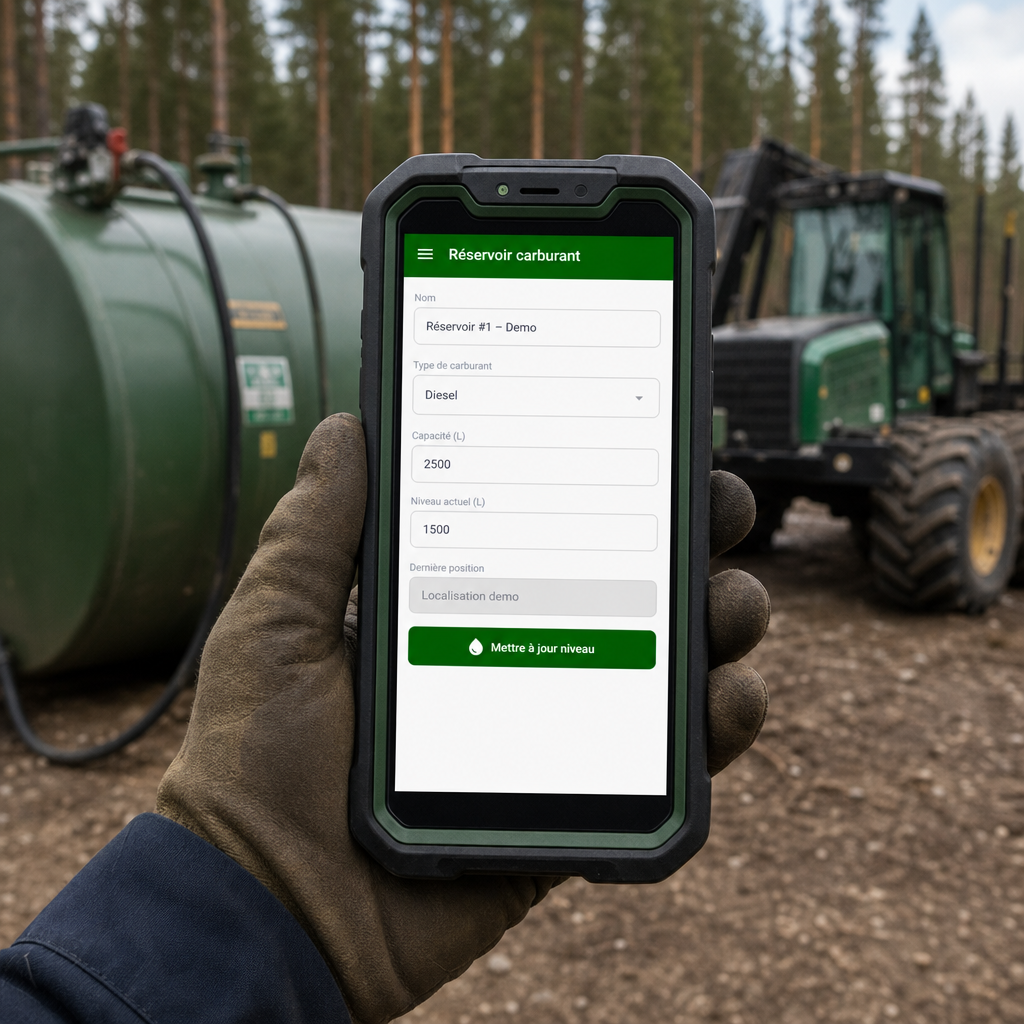
On a logging operation, fuel is one of the biggest expenses of the season. A harvester, a forwarder, a skidder: they drink diesel from morning to night. And yet it is often the least documented line item of the whole operation.
The scene plays out everywhere. The operator fills up at the mobile tank, scribbles a rough number on a scrap of cardboard, then heads back to the machine. In the evening, someone tries to reconstruct the day from memory. At month's end, the supplier's invoice shows up and doesn't quite match what was written down. And nobody really knows where the gap came from.
That fuzziness is expensive. Not only in lost liters, but in office time, in decisions made blind, and in invoices nobody can verify. The good news is that with MobileLogix, fuel tracking fits in a phone: one photo, a few taps, and the fill-up is filed.
Why manual fuel tracking almost always fails
The problem isn't that operators are careless. It's that the paper method is built to fail out in the bush:
- Fill-ups happen outdoors, often with gloves on, in dust or rain.
- The cardboard ends up greasy, unreadable, or lost in the bottom of the cab.
- The number is written down from memory, hours later.
- Nobody records with certainty which machine was fueled, or from which tank.
- The office receives partial data that then has to be reconciled by hand.
The end result: fuzzy fuel costs, gaps discovered too late, and no simple way to spot a machine burning more than it should.
The fill-up is logged on the spot, in a few taps
Here's how MobileLogix changes the routine. At the moment of fueling, the operator pulls out a phone or tablet and takes a photo of the meter. Then, in a few taps:
- They pick the equipment being fueled from their list of machines.
- They indicate which tank the fuel came from.
- They enter the number of liters and the meter reading.
The photo, the values and the choices stay attached to the fill-up, in the shift logbook. The whole thing takes a few seconds, gloves on, with no pencil or cardboard.
From tank to equipment: full traceability
On the ForestLogix side, at the office and in the cab, fuel isn't just an isolated photo. It's a complete chain, from the tank all the way to the machine. Each piece has its role:
- The photo of the meter serves as visual proof of the fill-up.
- The equipment and the tank, chosen by the operator, attach the fill-up to the right asset, with no guesswork at the office.
- The fill-up bundles the liters, the equipment, the date and the operator: a clean line in the shift logbook.
- Deferred upload sends everything once the network is back, so the data reaches the office without anything getting lost.
The tanks themselves are registered in the system too. A fuel truck, a fixed tank, a barrel on site: each becomes a known asset you select at fill-up time. So you know where the fuel came from, just as much as which machine it went into.
What it changes for Mélanie, Léo and Robert
For Mélanie, the operations coordinator, Monday morning is no longer a treasure hunt. She opens her screen and sees consumption by block and by equipment, with photos to back it up. No more three phone calls to operators to piece the weekend back together.
For Léo, the contractor, it's about control. He knows which machine burns how much, day after day. When a skidder starts drinking twice as much as usual in the same week, it jumps out. A breakdown brewing, a leak, abnormal use: he sees it coming before the invoice, not after.
For Robert, the executive, the fuel data has a second life. Once it's clean and filed, it can be compared to the supplier's invoice, sector by sector: the numbers match or they don't, and you see it right away. It also helps price the next contracts on real figures rather than guesswork. Reliable data at the start means a solid decision at the finish.
A concrete example, a Tuesday on the cut
Take an ordinary Tuesday. The fuel truck reaches the block in the morning. The forwarder operator fills up, pulls out the device, photographs the meter. They tap their forwarder in the list, pick the fuel truck as the source, enter the liters. About fifteen seconds, gloves on, and it's done.
In the afternoon, same thing for the harvester, at the other end of the cut block. The operator selects the machine, logs the fill-up, and moves on.
No cell coverage all day? No problem. Both fill-ups and their photos stay on the device. In the evening, on the way back to camp, the device catches a signal and everything flows back to the office without anyone having to think about it. Wednesday morning, Mélanie already has both fill-ups, photos included, filed under the right block and the right equipment. Nobody had to reconstruct a thing.
What the tool does not do (and why we say so)
We could be tempted to promise more. We won't. Here are the limits, stated plainly:
- It is not a connected gauge wired to the tank. Levels and fill-ups are entered by a person, not by a sensor.
- It is not a fraud detection system. The tool documents; it does not judge.
- It is not real-time synchronization. The photo reaches the office when the network comes back.
- It is not hooked up to the major oil companies. Supplier invoices are entered separately.
Why insist on this? Because a credible forestry tool is one that does exactly what it claims. That's also how we keep our clients' trust over the long run.
Built for the real field
Fueling often happens far from everything, deep in a cut block without a single bar of signal. That's accounted for. The photo and the data are first stored on the device, then sent to G.A. Logix cloud storage as soon as a connection returns, with repeated attempts until it goes through. Nothing is lost just because the network was down at the time of the fill-up.
That's the kind of detail our Quebec team cares a lot about. We code for people who work in the mud and the dust, not in an air-conditioned office wired to fiber.
How to get off to a good start
To get the most out of photo-based tracking, a few good habits help:
- Register your equipment and tanks in the system. The more up to date the list, the faster and more accurate the selection at fill-up time.
- Take a well-framed, readable photo of the meter. It's the visual proof of the fill-up, and it's worth its weight in gold when a figure is disputed.
- Enter the liters and the meter reading on the spot, while the information is fresh, rather than leaving it for the evening.
- Check now and then, at the office, that fill-ups are attached to the right block and the right equipment.
Nothing complicated here. The idea is that the data builds itself during normal work, with no extra office step at the end of the day.
In summary
- One photo and a few taps are enough to document a complete fill-up.
- The operator attaches each fill-up to the right machine and the right tank, on the spot.
- Every fill-up becomes a traceable line, with a photo, in the logbook.
- At the office, consumption reads by block and by equipment, without chasing anyone down.
- The tool stays honest about its limits: no magic gauge, no fraud detection, no real time.
Want to see this on your own operations? Request your free demonstration. We'll show you, machine by machine, how your fuel can finally track itself with no paperwork.