 G.A. Logix Software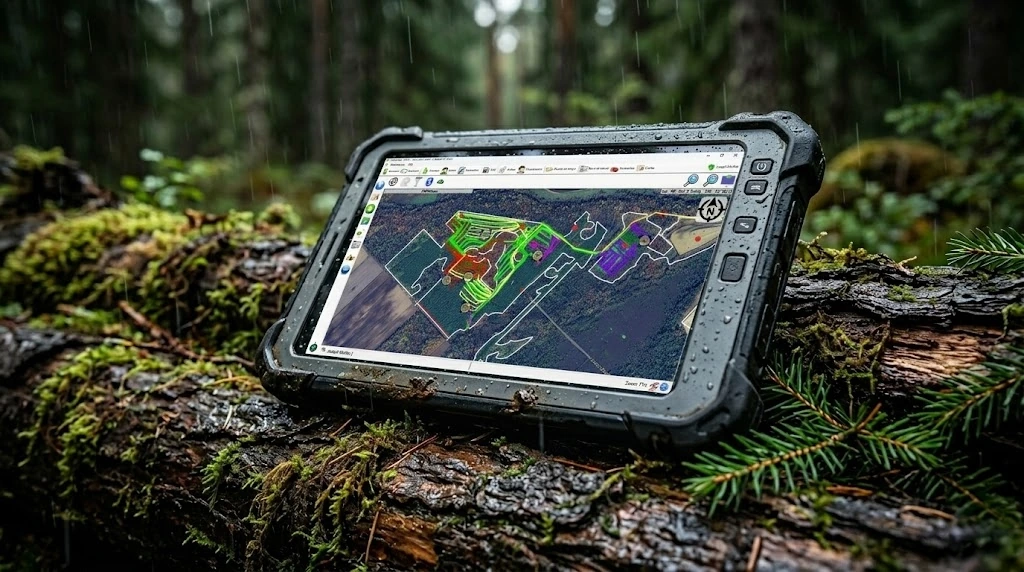
For decades, field data collection in forestry across Canada was done the same way: field notebooks, pre-printed paper forms, handheld GPS units and overflowing filing cabinets at the office. This model worked, but at an enormous cost in time, errors and inefficiency. Today, the transition to digital forest data collection apps is well underway, and companies that embrace it are discovering productivity gains they would not have thought possible. This guide details everything you need to know to successfully make the transition.
The evolution of forestry data collection in Canada
The history of terrain data collection in Canadian forestry can be summarized in three major phases. The first, dominated by paper and pencil, lasted until the early 2000s. Foresters filled out standardized forms in the field, brought them back to the office, and clerks transcribed them into databases or spreadsheets. Processing delays were measured in weeks, and error rates were significant.
The second phase saw the introduction of handheld GPS units and early desktop software, but without real integration. GPS data lived in one system, timesheets in another, production in a spreadsheet and government reports in a fourth. The proliferation of tools reduced some inefficiencies while creating new data silos.
The third phase, where we are now, is the era of integrated digital collection. A single field device, typically a rugged tablet, captures all data, validates it in real time and synchronizes it with the central system. This approach generates the most significant productivity gains.
Types of data collected on the forestry job site
The diversity of data collected on a forestry job site is often underestimated. A comprehensive field data collection application must be able to capture:
Geospatial data forms the foundation of every forestry operation. This includes GPS tracks (paths travelled, block boundaries), waypoints (points of interest, obstacles, stream crossings) and polygons (harvested areas, buffer zones, landing areas). The accuracy of this data is critical for regulatory compliance and planning.
Georeferenced photos visually document job site conditions, terrain conditions, environmental inspections and issues encountered. The automatic association of GPS coordinates and timestamps with each photo creates irrefutable documentation.
Operational data encompasses timesheets, production tracking by species and by machine, fuel logs, maintenance reports and delivery slips. This data feeds billing, payroll and performance reporting.
Inspections and forms include environmental surveys, compliance checks, forest road assessments and harvest quality evaluations. Each type of inspection has its own fields, validations and documentation requirements.
Unique challenges of data collection in the forest environment
No internet connectivity
The most fundamental challenge of field data collection in forestry is the near-total absence of cellular coverage on the majority of Canadian forestry job sites. Any forest data collection app that depends on an internet connection is unusable in this context. 100% offline operation is not an optional feature -- it is an absolute prerequisite. The application must locally store all data, maps, forms and references needed for daily work.
Extreme environmental conditions
Forestry job sites subject equipment to conditions that few other industries impose. Temperatures range from -40 degrees Celsius to +35 degrees Celsius depending on the season, rain, snow and dust are ever-present, and heavy equipment vibrations test the durability of any electronic device. Operators wear thick gloves that make using standard touchscreens practically impossible.
The need for rugged tablets
For these reasons, equipment selection is just as important as software selection. Military-grade rugged tablets (IP67, MIL-STD-810G certified) are the industry standard. These devices withstand drops of 1.2 metres onto concrete, operate in extreme temperature ranges and feature sunlight-readable screens with glove support. Investing in quality hardware is essential to ensure reliable data collection day after day.
Essential features of a field data collection application
Complete offline operation
Offline operation means all application features are available without a connection: form entry, GPS recording, photo capture, map and reference document consultation. Data entered offline is stored in a local database and synchronized automatically as soon as a connection is detected.
Bluetooth and cloud synchronization
Communication between field devices can occur via Bluetooth when multiple tablets need to share data without internet. Cloud synchronization via Wi-Fi or cellular network kicks in as soon as a connection is available, typically at the forest camp at the end of the day or near a road during travel.
Form customization and import
Every forestry company has specific data collection needs. A good forestry data collection application must offer form customization capabilities to adapt to each client's requirements and each type of operation.
Compatibility with open standards is a major asset. The XLSForm format, used by platforms like Fulcrum and ArcGIS Survey123, allows you to define complex forms with conditional logic, validations and automatic calculations in a simple Excel file. The ability to import these forms into the field application greatly accelerates the deployment of new collection types and lets you leverage the vast library of existing forms in the XLSForm ecosystem.
Artificial intelligence in field data collection
The integration of artificial intelligence into field data collection applications opens new possibilities for foresters. As detailed in our article on AI integration in MobileLogix, recent advances enable previously unimaginable field capabilities.
The intelligent forestry chatbot embedded in the application answers operators' technical questions in real time: species identification, scaling standards, cutting regulations and best practices. This knowledge base, accessible in the forest, reduces errors linked to lack of information and accelerates the training of new employees.
Intelligent voice reading allows equipment operators to consult responses and instructions without taking their eyes off the job site, a critical feature for cab safety. The system reads information phrase by phrase, at a natural pace adapted to the work context.
Automatic report generation transforms raw data collected during the day into structured reports ready to be sent to the client. What used to take hours of manual compilation at the end of the day now happens in seconds thanks to AI.
Data synchronization: the critical link
The value of data collected in the field is only realized when it reaches the office. SyncLogix ensures this field data synchronization reliably and transparently. The system automatically detects available network connections (Wi-Fi, cellular) and transmits data bidirectionally: field data uploads to the server, and planning updates download to the tablets.
The synchronization is designed to be resilient: if the connection is interrupted, the transfer resumes exactly where it left off. Data conflicts, when the same information has been modified in both the field and the office, are managed by configurable priority rules. The result is a central database that is always up to date and reflects the true state of operations.
Government compliance: regulatory reporting and data export
Compliance with provincial forestry ministry requirements is an unavoidable obligation for every forestry company in Canada. Field activity reports must be produced in specific formats and contain data structured according to government standards.
A well-designed forestry data collection application integrates these standards directly into its data entry forms. Automatic validations check data compliance at the time of entry rather than after the fact, avoiding rejections and late corrections. Report export takes just a few clicks, producing a file that conforms to ministry specifications and is ready for submission without modification.
Government data standards evolve regularly. Actively maintained software incorporates these changes proactively, ensuring your data is always compliant with the latest requirements without manual intervention on your part.
Go from paper to digital now
The transition from paper to digital for field data collection is no longer a future project -- it is a present necessity. Companies that continue with manual processes lose time, money and competitiveness every day. The good news is that solutions are mature, proven and adapted to the specific realities of Canadian forestry.
G.A. Logix has been supporting forestry companies in this transition for over two decades. Our solutions were designed in the field, tested in the most demanding conditions and deployed to hundreds of users across Canada. Contact our team for a personalized demonstration and discover how to transform your field data collection.